2. Matrix based transforms#
In the last notebook 1_getting_started_with_robot_ik.ipynb we have familiarized ourselves with the concept of Forward and Inverse Kinematics (IK) and implemented a simple IK solver for a 3DOF leg using trigonometry. In this notebook we will use SciPy to implement a more advanced IK solver using matrix transformations.
SciPy, a Python library built upon NumPy, provides a wide array of mathematical algorithms and functions that are valuable for robotics, including linear algebra, which is of interest here.
Setting up the Jupyter notebook for experimentation#
This documentation has been generated from a Jupyter notebook and is available in the repo source code (see link below).
The next couple of cells are designated to the setup of the notebook environment. If you are not interested in the experimentation and only want to read the documentation, feel free to skip them.
The first step is to enable live python modules reloading, so changes in the python code of imported files are immediately reflected in the notebook without restarting the kernel.
# Enable python modules live reloading
%load_ext autoreload
%autoreload 2
The next step is configuring matplotlib backend. Widget backend allows to interact with the plots in the notebook and is supported in Google Colab and VSCode.
%config InlineBackend.figure_formats = ['svg']
%matplotlib widget

from IPython.display import display
import matplotlib.pyplot as plt

plt.ioff()  # this is equivalent to using inline backend, but figures have to be displayed manually
<contextlib.ExitStack at 0x7cdeec9afe60>
Affine transforms#
The first step is to convert our forward kinematics code from custom Points and hand crafted function to use matrix transforms for rotation and translation.
Alongside the conversion, we are going to bring all the algorithms to work in full 3D space, not just 2D projections.
import numpy as np
from point import Leg3D, Line3D, Point3D
from scipy.spatial.transform import Rotation as R


def forward_kinematics(
    coxa_length,
    femur_length,
    tibia_length,
    alpha,
    beta,
    gamma,
    start_height=2,
    body_length=5,
):
    # Define initial points in local coordinates
    start_point = Point3D([0, start_height, 0])
    body_local = Point3D([body_length, 0, 0])
    coxa_local = Point3D([coxa_length, 0, 0])
    femur_local = Point3D([femur_length, 0, 0])
    tibia_local = Point3D([tibia_length, 0, 0])

    # Create rotation matrices
    rotation_axis = np.array([0, 0, 1])
    r_alpha = R.from_rotvec(rotation_axis * alpha, degrees=True)
    r_beta = R.from_rotvec(rotation_axis * beta, degrees=True)
    r_gamma = R.from_rotvec(rotation_axis * gamma, degrees=True)

    # Calculate global positions using transformations
    body_point = start_point + body_local

    # Apply alpha rotation to coxa
    coxa_rotated = r_alpha.apply(coxa_local.numpy())
    coxa_point = body_point + coxa_rotated

    # Apply alpha+beta rotation to femur
    r_alpha_beta = r_alpha * r_beta
    femur_rotated = r_alpha_beta.apply(femur_local.numpy())
    femur_point = coxa_point + femur_rotated

    # Apply alpha+beta+gamma rotation to tibia
    r_alpha_beta_gamma = r_alpha_beta * r_gamma
    tibia_rotated = r_alpha_beta_gamma.apply(tibia_local.numpy())
    tibia_point = femur_point + tibia_rotated

    # Set  Point labels for visualization
    body_point.label = rf'$\alpha$={alpha}°'
    coxa_point.label = rf'$\beta$={beta}°'
    femur_point.label = rf'$\gamma$={gamma}°'
    tibia_point.label = 'Foot'

    # Return lines connecting the points
    return Leg3D(
        [
            Line3D(start_point, body_point, 'Body'),
            Line3D(body_point, coxa_point, 'Coxa'),
            Line3D(coxa_point, femur_point, 'Femur'),
            Line3D(femur_point, tibia_point, 'Tibia'),
        ]
    )
from plotting import plot_leg_with_points

coxa = 5
femur = 8
tibia = 10


model = forward_kinematics(coxa, femur, tibia, 45, -55, -14)

_ = plot_leg_with_points(
    model.xy, 'Foot on the ground (XY)', link_labels='none', x_label="X'", y_label='Y'
)
display(plt.gcf())
plt.close(plt.gcf())

_ = plot_leg_with_points(
    model.xz, 'Foot on the ground (XZ)', link_labels='none', x_label="X'", y_label='Z'
)
display(plt.gcf())
plt.close(plt.gcf())
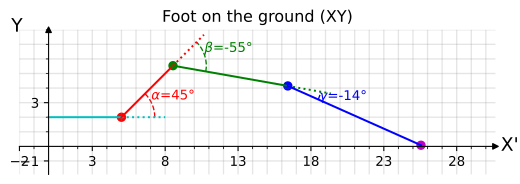
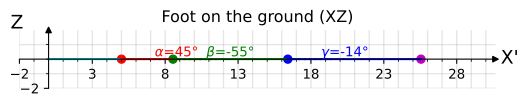
This was a good start, but code is hard to read and understand due to excessive repetitions. Let’s introduce a transform system, similar to the one used in ROS TF2 library.
With this Transform class we can now create a chain of transformations instead of hand crafting them.
from plotting import plot_leg3d
from transforms import Transform


def forward_kinematics_transforms(
    coxa_length,
    femur_length,
    tibia_length,
    alpha,
    beta,
    gamma,
    leg_location_on_body=[0, 0, 0],
    leg_rotation=[0, 0, 0],
    body_transform=Transform.identity(),
    verbose=False,
):
    # Create rotation matrices and transforms
    body_link = body_transform @ Transform.from_translation(leg_location_on_body)
    body_joint = body_link @ Transform.from_rotvec(leg_rotation, degrees=True)

    coxa_joint = body_joint @ Transform.from_rotvec([0, 0, alpha], degrees=True)
    coxa_link = coxa_joint @ Transform.from_translation([coxa_length, 0, 0])

    femur_joint = coxa_link @ Transform.from_rotvec([0, beta, 0], degrees=True)
    femur_link = femur_joint @ Transform.from_translation([femur_length, 0, 0])

    tibia_joint = femur_link @ Transform.from_rotvec([0, gamma, 0], degrees=True)
    tibia_link = tibia_joint @ Transform.from_translation([tibia_length, 0, 0])

    # Calculate global positions using transformations
    identity_point = Point3D([0, 0, 0])

    body_start = body_transform.apply_point(identity_point)

    body_end = body_link.apply_point(identity_point)
    body_end.label = rf'$\alpha$={alpha}°'

    coxa_end = coxa_link.apply_point(identity_point)
    coxa_end.label = rf'$\beta$={beta}°'

    femur_end = femur_link.apply_point(identity_point)
    femur_end.label = rf'$\gamma$={gamma}°'

    tibia_end = tibia_link.apply_point(identity_point)
    tibia_end.label = 'Foot'

    result = Leg3D(
        [
            Line3D(body_start, body_end, 'Body'),
            Line3D(body_end, coxa_end, 'Coxa'),
            Line3D(coxa_end, femur_end, 'Femur'),
            Line3D(femur_end, tibia_end, 'Tibia'),
        ]
    )

    if verbose:
        print(f'{body_end=}')
        print(f'{coxa_end=}')
        print(f'{femur_end=}')
        print(f'{tibia_end=}')
        for line in result:
            print(line)

    return result


coxa = 5
femur = 8
tibia = 10

model = forward_kinematics_transforms(coxa, femur, tibia, 0, -25, 110)

fig, _, _ = plot_leg_with_points(
    model.xy,
    'Foot in 3D (XY)',
    link_labels='none',
    joint_labels='points',
    x_label='X',
    y_label='Y',
    subplot=221,
)
_ = plot_leg_with_points(
    model.xz,
    'Foot in 3D (XZ)',
    link_labels='none',
    joint_labels='points',
    x_label='X',
    y_label='Z',
    subplot=222,
    fig=fig,
)
_ = plot_leg_with_points(
    model.yz,
    'Foot in 3D (YZ)',
    link_labels='none',
    joint_labels='points',
    x_label='Y',
    y_label='Z',
    subplot=223,
    fig=fig,
)
fig, ax, plot_data = plot_leg3d(
    model,
    'Foot in 3D',
    link_labels='none',
    joint_labels='points',
    subplot=224,
    fig=fig,
    hide_grid=False,
)
ax.plot(*zip([0, -5, 0], [0, 5, 0]), 'w:')  # add depth
ax.set_aspect('equal')  # Upset the aspect ratio
display(fig)
plt.close(fig)
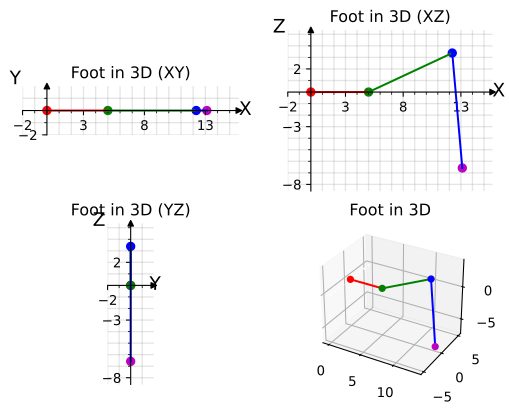
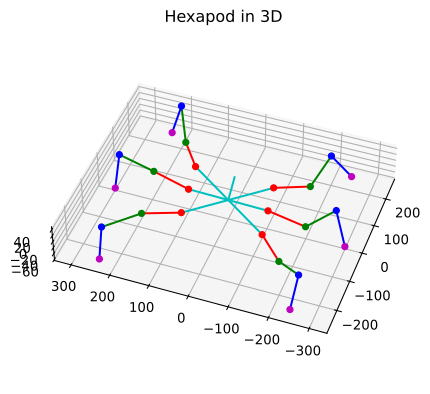
With full 3D kinematics model and plotting support lets setup a 6 legged robot.
# Dr.QP Dimensions
from models import LegModel
from plotting import plot_update_leg3d_lines

drqp_front_offset = 0.116924  # x offset for the front and back legs
drqp_side_offset = 0.063871  # y offset fo the front and back legs
drqp_middle_offset = 0.103  # x offset for the middle legs

drqp_coxa = 0.053
drqp_femur = 0.066225
drqp_tibia = 0.123


class DrQP:
    def __init__(self, coxa_len=drqp_coxa, femur_len=drqp_femur, tibia_len=drqp_tibia):
        self.left_front_leg = LegModel(
            coxa_len,
            femur_len,
            tibia_len,
            label='left_front',
            rotation=[0, 0, 45],
            location_on_body=[drqp_front_offset, drqp_side_offset, 0.0],
        )
        self.left_middle_leg = LegModel(
            coxa_len,
            femur_len,
            tibia_len,
            label='left_middle',
            rotation=[0, 0, 90],
            location_on_body=[0.0, drqp_middle_offset, 0.0],
        )
        self.left_back_leg = LegModel(
            coxa_len,
            femur_len,
            tibia_len,
            label='left_back',
            rotation=[0, 0, 135],
            location_on_body=[-drqp_front_offset, drqp_side_offset, 0.0],
        )

        self.right_front_leg = LegModel(
            coxa_len,
            femur_len,
            tibia_len,
            label='right_front',
            rotation=[0, 0, -45],
            location_on_body=[drqp_front_offset, -drqp_side_offset, 0.0],
        )
        self.right_middle_leg = LegModel(
            coxa_len,
            femur_len,
            tibia_len,
            label='right_middle',
            rotation=[0, 0, -90],
            location_on_body=[0.0, -drqp_middle_offset, 0.0],
        )
        self.right_back_leg = LegModel(
            coxa_len,
            femur_len,
            tibia_len,
            label='right_back',
            rotation=[0, 0, -135],
            location_on_body=[-drqp_front_offset, -drqp_side_offset, 0.0],
        )
        self.update_head()

    def forward_kinematics(self, alpha, beta, gamma):
        for leg in self.legs:
            leg.forward_kinematics(alpha, beta, gamma)

    @property
    def legs(self):
        return [
            self.left_front_leg,
            self.left_middle_leg,
            self.left_back_leg,
            self.right_front_leg,
            self.right_middle_leg,
            self.right_back_leg,
        ]

    @property
    def body_transform(self):
        return self.left_front_leg.body_transform

    @body_transform.setter
    def body_transform(self, value):
        for leg in self.legs:
            leg.body_transform = value

        self.update_head()

    def update_head(self):
        # Head, x-forward
        self.head = Line3D(
            self.body_transform.apply_point(Point3D([0, 0, 0])),
            self.body_transform.apply_point(Point3D([drqp_front_offset, 0, 0])),
            'Head',
        )


def plot_drqp(drqp, targets=None):
    fig, ax = None, None

    class PlotData:
        def __init__(self):
            self.leg_plot_data = []
            self.head_line = None

    plot_data = PlotData()

    for leg in drqp.legs:
        fig, ax, leg_plot_data = plot_leg3d(
            leg,
            'Hexapod in 3D',
            link_labels='none',
            joint_labels='points',
            subplot=111,
            fig=fig,
            ax=ax,
        )
        plot_data.leg_plot_data.append(leg_plot_data)

    plot_data.head_line = ax.plot(*zip(drqp.head.start, drqp.head.end), 'c')[0]

    if targets:
        ax.scatter(
            *zip(*[target.numpy() for target in targets]),
            color='k',
            label='unreachable target',
        )

    ax.view_init(elev=44.0, azim=-160)
    return fig, ax, plot_data


def update_drqp_plot(drqp, plot_data):
    for leg, leg_plot_data in zip(drqp.legs, plot_data.leg_plot_data):
        plot_update_leg3d_lines(leg, leg_plot_data)

    if plot_data.head_line:
        plot_data.head_line.set_data_3d(*zip(drqp.head.start, drqp.head.end))


drqp = DrQP()
drqp.forward_kinematics(0, -25, 110)
fig, ax, plot_data = plot_drqp(drqp)
display(fig)
plt.close(fig)
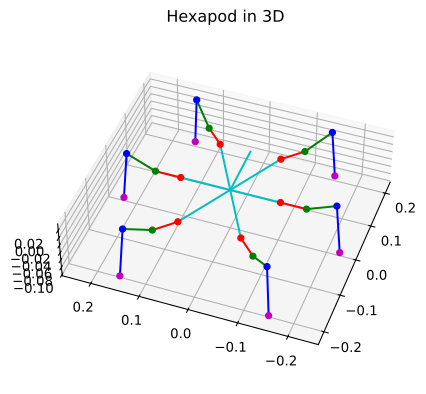
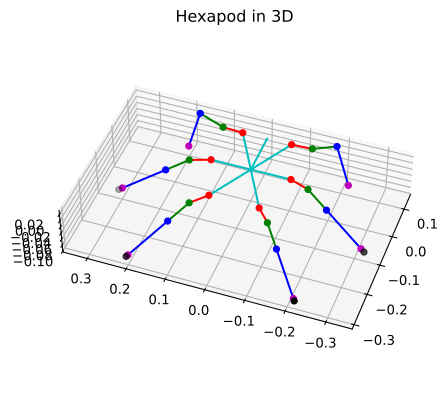
With the ability to do forward kinematics for a full robot, we can now start to work on the inverse kinematics. 1_getting_started_with_robot_ik.ipynb notebook covers the full 3D case of a single leg IK, however it works in the leg’s local coordinate frame. In order to use it for the full robot, each leg global target position needs to be converted to the leg’s local coordinate frame. Since we used matrix transformations for the forward kinematics, we can use the inverse of the body transform to convert the global target to the local coordinate frame.
    def to_local(self, point):
        return self.body_joint.inverse().apply_point(point)
orig_alpha, orig_beta, orig_gamma = 0, -25, 110
drqp = DrQP()
drqp.forward_kinematics(orig_alpha, orig_beta, orig_gamma)

targets = []
for leg in drqp.legs:
    target = leg.tibia_end.copy()
    target.label = 'Target'
    target.x -= 0.08
    target.y *= 1.4

    reached = leg.move_to(target)
    if not reached:
        target.label = 'Unreachable target'
        targets.append(target)
        print(f'Leg {leg.label} failed to reach {target}, ended at {leg.tibia_end}')

fig, ax, plot_data = plot_drqp(drqp, targets)
display(fig)
plt.close(fig)
Leg left_middle failed to reach Point3D(-0.0800, 0.3174, -0.0945, Unreachable target), ended at Point3D(-0.0768, 0.3088, -0.0896, Foot)
Leg left_back failed to reach Point3D(-0.2844, 0.2119, -0.0945, Unreachable target), ended at Point3D(-0.2806, 0.2086, -0.0917, Foot)
Leg right_middle failed to reach Point3D(-0.0800, -0.3174, -0.0945, Unreachable target), ended at Point3D(-0.0768, -0.3088, -0.0896, Foot)
Leg right_back failed to reach Point3D(-0.2844, -0.2119, -0.0945, Unreachable target), ended at Point3D(-0.2806, -0.2086, -0.0917, Foot)
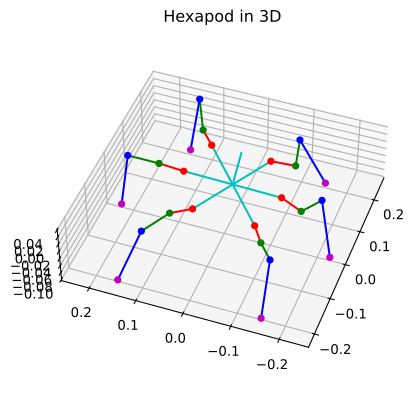
With the ability to position all legs, its time to work on the inverse kinematics for the body.
The algorithm is as follows:
Capture the reference stance
Run forward kinematics for all legs with the same angles in a desired position (neutral, wide, narrow, specific gait).
Capture global positions of all leg foot tips
Apply transform to the robot’s body (translation, rotation, twist).
Run inverse kinematics for all legs with the foot positions captured in step 1.
orig_alpha, orig_beta, orig_gamma = 0, -25, 110
drqp = DrQP()
drqp.forward_kinematics(orig_alpha, orig_beta, orig_gamma)

targets = [leg.tibia_end.copy() for leg in drqp.legs]

drqp.body_transform = Transform.from_translation([0.05, 0, -0.01]) @ Transform.from_rotvec(
    [10, 10, 10], degrees=True
)

unreachable_targets = []
for leg, target in zip(drqp.legs, targets):
    reached = leg.move_to(target)
    if not reached:
        target.label = 'Unreachable target'
        unreachable_targets.append(target)
        print(f'Leg {leg.label} failed to reach {target}, ended at {leg.tibia_end}')

fig, ax, plot_data = plot_drqp(drqp, unreachable_targets)
display(fig)
plt.close(fig)
import math

steps = 64
x = 0.0
y = 0.0
z = 0.0
scalar = 0.05
sequence_xy_little_circle = [
    Transform.from_translation([x + math.cos(i) * scalar, y + math.sin(i) * scalar, z])
    for i in np.linspace(np.pi, np.pi * 3, steps)
]

sequence_xz_little_circle = [
    Transform.from_translation([x + math.sin(i) * scalar, y, z + math.cos(i) * scalar])
    for i in np.linspace(0, np.pi * 2, steps)
]

sequence_yz_little_circle = [
    Transform.from_translation([x, y + math.sin(i) * scalar, z + math.cos(i) * scalar])
    for i in np.linspace(0, np.pi * 2, steps)
]

sequence_xyz_little_circle = [
    Transform.from_translation(
        [x + math.cos(i) * scalar, y + math.sin(i) * scalar, z + math.cos(i) * scalar]
    )
    for i in np.linspace(0, np.pi * 2, steps)
]
# Plot IK solutions and targets into an animation

import matplotlib.pyplot as plt
from plotting import animate_plot, is_sphinx_build
from scipy.interpolate import interp1d

plt.rcParams['animation.html'] = 'jshtml'

skip = not is_sphinx_build()
interactive = False
save_animation = False

orig_alpha, orig_beta, orig_gamma = 0, -25, 110
drqp = DrQP()
drqp.forward_kinematics(orig_alpha, orig_beta, orig_gamma)

targets = [leg.tibia_end.copy() for leg in drqp.legs]

transforms = [Transform.identity()]


def interpolate(tf1: Transform, tf2: Transform, steps=10):
    interp_func = interp1d([0, steps], np.stack([tf1.matrix, tf2.matrix]), axis=0)
    for i in range(steps):
        transforms.append(Transform(interp_func(i)))


def extend_transforms(ohter_transforms, steps=10):
    interpolate(transforms[-1], ohter_transforms[0], steps=steps)
    transforms.extend(ohter_transforms)


def turn_transforms(axis, turn_degrees=10):
    axis = np.array(axis)
    for i in range(0, turn_degrees):
        transforms.append(Transform.from_rotvec(axis * i, degrees=True))

    for i in range(turn_degrees, -turn_degrees, -1):
        transforms.append(Transform.from_rotvec(axis * i, degrees=True))

    for i in range(-turn_degrees, 0):
        transforms.append(Transform.from_rotvec(axis * i, degrees=True))


turn_transforms([0, 0, 1])
turn_transforms([0, 1, 0])
turn_transforms([1, 0, 0])
turn_transforms([1, 1, 0])
turn_transforms([1, 0, 1])
turn_transforms([1, 1, 1])

extend_transforms(sequence_xy_little_circle, steps=5)
extend_transforms(sequence_xz_little_circle, steps=5)
extend_transforms(sequence_yz_little_circle, steps=5)
extend_transforms(sequence_xyz_little_circle, steps=5)

# Close the loop
interpolate(transforms[-1], transforms[0], steps=15)

fig, ax, plot_data = plot_drqp(drqp)


def animate(frame):
    drqp.body_transform = transforms[frame]
    for leg, target in zip(drqp.legs, targets):
        leg.move_to(target)
    update_drqp_plot(drqp, plot_data)


if not skip:
    animate_plot(
        fig,
        animate,
        _frames=len(transforms),
        _interval=20,
        _interactive=interactive,
        _save_animation_name='animation' if save_animation else None,
    )
---------------------------------------------------------------------------
RuntimeError                              Traceback (most recent call last)
File ~/checkouts/readthedocs.org/user_builds/drqp/envs/stable/lib/python3.12/site-packages/IPython/core/formatters.py:406, in BaseFormatter.__call__(self, obj)
    404     method = get_real_method(obj, self.print_method)
    405     if method is not None:
--> 406         return method()
    407     return None
    408 else:

File ~/checkouts/readthedocs.org/user_builds/drqp/envs/stable/lib/python3.12/site-packages/matplotlib/animation.py:1385, in Animation._repr_html_(self)
   1383 fmt = mpl.rcParams['animation.html']
   1384 if fmt == 'html5':
-> 1385     return self.to_html5_video()
   1386 elif fmt == 'jshtml':
   1387     return self.to_jshtml()

File ~/checkouts/readthedocs.org/user_builds/drqp/envs/stable/lib/python3.12/site-packages/matplotlib/animation.py:1302, in Animation.to_html5_video(self, embed_limit)
   1299 path = Path(tmpdir, "temp.m4v")
   1300 # We create a writer manually so that we can get the
   1301 # appropriate size for the tag
-> 1302 Writer = writers[mpl.rcParams['animation.writer']]
   1303 writer = Writer(codec='h264',
   1304                 bitrate=mpl.rcParams['animation.bitrate'],
   1305                 fps=1000. / self._interval)
   1306 self.save(str(path), writer=writer)

File ~/checkouts/readthedocs.org/user_builds/drqp/envs/stable/lib/python3.12/site-packages/matplotlib/animation.py:121, in MovieWriterRegistry.__getitem__(self, name)
    119 if self.is_available(name):
    120     return self._registered[name]
--> 121 raise RuntimeError(f"Requested MovieWriter ({name}) not available")

RuntimeError: Requested MovieWriter (ffmpeg) not available
<matplotlib.animation.FuncAnimation at 0x7cdec953ef30>
To make all the learnings and findings reusable in other notebooks, lets move all the code into modules and double check it works.
from models import HexapodModel
from plotting import plot_hexapod, update_hexapod_plot

hexapod = HexapodModel()
hexapod.forward_kinematics(0, -25, 110)
fig, ax, plot_data = plot_hexapod(hexapod)

leg_tips = [leg.tibia_end.copy() for leg in hexapod.legs]

hexapod.body_transform = Transform.from_translation([0.05, 0, -0.01]) @ Transform.from_rotvec(
    [10, 10, 10], degrees=True
)
hexapod.move_legs_to(leg_tips)
update_hexapod_plot(hexapod, plot_data)
display(fig)
plt.close(fig)